Plenty of travellers drive straight through New Brunswick on their way to Nova Scotia or PEI. That’s a mistake: the province can easily fill a week, even two. It’s also unique in Canada as the only officially bilingual province — around a third of its people are French-speaking, many of them Acadian — so you’ll hear both languages and get a real taste of Acadian culture along the way.
Seen from Edmundston, in the province’s northwest corner, here are our 20 highlights, grouped into four regions to make planning easier.
At a glance
- Recommended time: 7 days for the essentials, 10–14 days to go deeper.
- Best time: June to September; late September to early October for fall colours.
- Languages: English and French; the north and east are mostly French-speaking.
- Getting there: the Trans-Canada Highway from Québec via Edmundston; border crossings from Maine (St. Stephen–Calais, Woodstock–Houlton and others); airports in Moncton, Fredericton and Saint John.
- Time zone: Atlantic Time — one hour ahead of Ontario, Québec and the US East Coast.
In this guide
- The Fundy coast: tides and cliffs
- The Acadian coast: beaches and culture
- The Saint John River valley: Fredericton to Edmundston
- The wild north
- Suggested 7-day New Brunswick itinerary
- Where to stay
- Driving times
- Coming from Ontario, the US or overseas
- A taste of Acadia
- Rainy-day ideas
- How long to spend in each region
- Frequently asked questions
- Sources
The Fundy coast: tides and cliffs
1. Hopewell Rocks
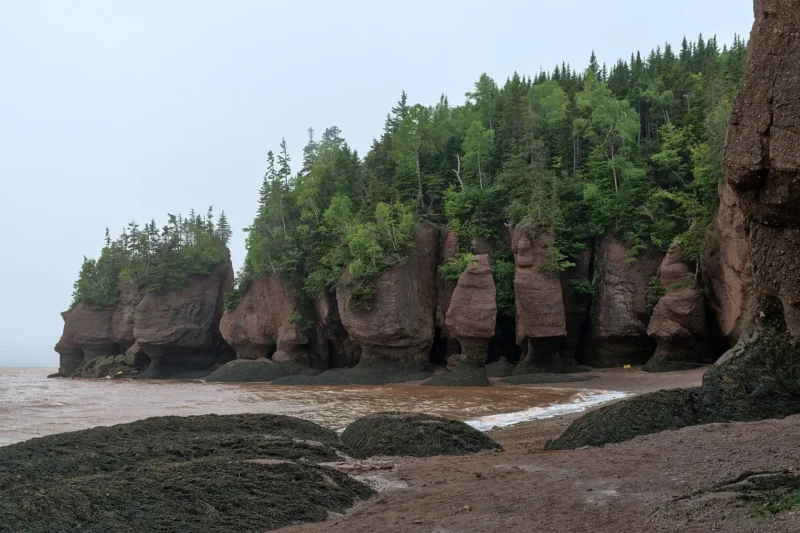
New Brunswick’s most famous sight: at low tide you walk on the ocean floor among flowerpot-shaped sea stacks; at high tide you paddle around them. The provincial park is open seasonally (May 15 to October 25 in 2026) and tickets are valid for two consecutive days. Check the tide table before you go — full details in our Bay of Fundy guide.
2. Fundy National Park
Forests, waterfalls (including Dickson Falls), the Point Wolfe covered bridge and coves that empty at low tide, with the lobster village of Alma at the park gate.
3. Fundy Trail Parkway
A scenic road of about 30 km between St. Martins and the Sussex area, with lookouts, beaches, a suspension bridge and Walton Glen Gorge. Open roughly mid-May to mid-October.
4. Saint John and the Reversing Falls
Canada’s oldest incorporated city (1785) is known for its Reversing Falls, where the river current flips with the tide, its covered City Market and the Stonehammer UNESCO Global Geopark.
5. St. Andrews and the whales
A historic seaside town on Passamaquoddy Bay: old homes, Kingsbrae Garden, whale-watching tours from June to October and Ministers Island, reachable at low tide across a sandbar.
6. Grand Manan Island
About an hour and a half by ferry from Blacks Harbour: cliffs, lighthouses, fishing villages and seabirds. A world of its own.
The Acadian coast: beaches and culture
7. Shediac and Parlee Beach
The self-proclaimed “Lobster Capital of the World” (complete with a giant lobster sculpture) is one of the Maritimes’ most popular beach towns. At Parlee Beach Provincial Park, the Northumberland Strait is among the warmest water in the region in summer.
8. Bouctouche: the Dune and Le Pays de la Sagouine
The Bouctouche Dune, explored on a long boardwalk at the Irving Eco-Centre, is one of the few remaining great sand dunes on the northeastern coast of North America. Nearby, Le Pays de la Sagouine brings Antonine Maillet’s Acadian characters to life through theatre and music on a small island (mostly in French). 2026 season: June 21 to September 6.
9. Kouchibouguac National Park
Lagoons, dunes, salt marshes, forest and around 60 km of cycling trails. Kellys Beach, reached by a boardwalk over the marshes, is a must. It’s also one of the best places in the province to see seals and shorebirds.
10. Caraquet and the Acadian Historical Village
The cultural capital of Acadia comes alive every summer with its Acadian Festival, peaking with the Tintamarre on August 15, Acadia’s National Day — a joyful, noisy street parade. Nearby, the Acadian Historical Village (Village historique acadien) recreates Acadian life from 1770 to 1949 with costumed interpreters (2026 season: June 4 to September 26).
11. Lamèque and Miscou
At the tip of the Acadian Peninsula, Lamèque and Miscou islands offer peat bogs, wild beaches and the Miscou Lighthouse at the end of the road.
12. Moncton and the Petitcodiac tidal bore
The province’s largest city is a practical base, home to Magnetic Hill and the tidal bore, a wave that pushes up the Petitcodiac River on the incoming tide (check the predicted times).
The Saint John River valley: Fredericton to Edmundston
13. Fredericton
The provincial capital charms with its historic Garrison District, the Beaverbrook Art Gallery and riverside trails along the Saint John River.
14. Kings Landing
Near Fredericton, this living-history village recreates rural life in 19th-century New Brunswick.
15. The Hartland Covered Bridge
At 391 m (1,282 ft), it’s the longest covered bridge in the world. Driving (or walking) across it is a rite of passage.
16. Grand Falls Gorge
In Grand Falls (Grand-Sault), the Saint John River plunges into a dramatic gorge. Lookouts, trails and walkways let you see it from several angles; the flow varies with the seasons and dam operations.
17. Edmundston and Madawaska
The gateway from Québec, Edmundston is the heart of the “Republic of Madawaska” and Brayon culture. Don’t miss the New Brunswick Botanical Garden, the Petit-Témis Interprovincial Linear Park (134 km of trail to Rivière-du-Loup, Québec) and, in summer, the Foire Brayonne, one of the biggest francophone festivals in eastern Canada.
The wild north
18. Mount Carleton Provincial Park
Mount Carleton (about 820 m) is the highest peak in the Maritimes. The park is vast and quiet — perfect for hiking, canoeing and stargazing.
19. Chaleur Bay and Campbellton
From Bathurst to Campbellton, Chaleur Bay offers beaches, villages and views across the water to the Gaspé. From Campbellton, the Gaspé Peninsula is just one bridge away.
20. Back roads and covered bridges
The province still has several dozen covered bridges. Leave the highway now and then: that’s where New Brunswick really shows itself.
Suggested 7-day New Brunswick itinerary
| Day | Plan | Overnight |
|---|---|---|
| 1 | Edmundston (Botanical Garden), Grand Falls, Hartland Bridge | Fredericton |
| 2 | Fredericton and Kings Landing | Fredericton |
| 3 | St. Andrews: whales and Ministers Island | St. Andrews |
| 4 | Saint John, St. Martins, Fundy Trail Parkway | Alma |
| 5 | Fundy National Park, Hopewell Rocks | Moncton |
| 6 | Shediac, Bouctouche, Kouchibouguac | Kouchibouguac / Richibucto |
| 7 | Caraquet and the Acadian Historical Village | Caraquet |
Coming from the US? Flip it: enter at St. Stephen, start with St. Andrews and the Fundy coast, and finish in the Saint John River valley before heading back via Woodstock–Houlton. Either way, fit days 4 and 5 around the tides.
Where to stay
- Alma or St. Andrews for the Bay of Fundy: the first for the national park and Hopewell Rocks, the second for whales and historic charm.
- Moncton or Shediac for the southeast: Moncton has the most hotels and restaurants, Shediac the beach-town vibe.
- Caraquet for the Acadian Peninsula.
- Fredericton or Edmundston for the Saint John River valley.
In July and August, book early on the coast (Alma, St. Andrews, Shediac) and in national park campgrounds. Out of season, many inns and attractions close, so always check opening dates.
Driving times
New Brunswick is bigger than it looks, so plan your driving. Approximate times without stops: Edmundston to Fredericton about 3 hours; Fredericton to Saint John about 1.25 hours; Saint John to Alma about 1.5 hours; Alma to Moncton about 1 hour; Moncton to Shediac about 25 minutes; Moncton to Caraquet about 3 hours. Add time for photo stops, roadworks and slow summer traffic on coastal roads.
Coming from Ontario, the US or overseas
- From Ontario: the drive from Toronto follows Highway 401 and Québec’s Autoroute 20 to Rivière-du-Loup, then Autoroute 85 to Edmundston — a long two-day trip, best broken up in Montréal or Québec City.
- From New England: cross at St. Stephen–Calais for the Fundy coast or at Houlton–Woodstock for Fredericton. Bring your passport and remember to set your watch an hour ahead.
- From the UK and Europe: most visitors fly into Halifax, Montréal or Toronto and connect to Moncton, Fredericton or Saint John, or rent a car in Halifax — Moncton is under three hours away.
A taste of Acadia
Don’t leave the Acadian coast without trying its food: poutine râpée (a grated-potato dumpling stuffed with pork — nothing like Québec poutine), chicken fricot, rappie pie (pâté à la râpure) and, for dessert, pets de sœur cinnamon rolls. Add Shediac lobster, Acadian Peninsula oysters and Fundy seafood. The farmers’ markets in Moncton, Dieppe and Saint John are great places to sample local products.
Rainy-day ideas
Fundy fog and summer showers happen. Good indoor (or rain-proof) options:
- Museums and galleries in Fredericton and Saint John, including the Beaverbrook Art Gallery and the New Brunswick Museum in Saint John.
- Saint John’s City Market, for local food and crafts under one roof.
- The Acadian Historical Village near Caraquet, where many buildings are indoors and the interpreters work rain or shine.
- Hopewell Rocks in the rain — honestly, the tide doesn’t care, and the crowds are thinner. Just bring good boots.
- A lobster or seafood supper in Shediac or Alma, the best possible cure for grey weather.
How long to spend in each region
| Region | Suggested time | Best for |
|---|---|---|
| Fundy coast | 3–4 days | Nature, tides, hiking, whales |
| Acadian coast | 2–4 days | Beaches, Acadian culture, families |
| Saint John River valley | 1–2 days | History, scenic drives |
| North (Mount Carleton, Chaleur Bay) | 1–3 days | Wilderness, peace and quiet |
- Huge variety: unique tides, warm beaches, forests and Acadian culture.
- Less crowded than its neighbours, often with gentler prices.
- A great introduction to French-speaking Acadia, with services in English everywhere.
- Long distances between regions: a car is essential.
- Short tourist season; many attractions close after Labour Day.
- Changeable weather and frequent fog on the Fundy coast.
Frequently asked questions
What is New Brunswick best known for?
The Bay of Fundy and its record tides (Hopewell Rocks), Acadian culture, warm-water beaches on the Northumberland Strait, covered bridges — including the world’s longest at Hartland — and being Canada’s only officially bilingual province.
What can you do in New Brunswick in a week?
Combine the Fundy coast (St. Andrews, Fundy Trail Parkway, Fundy National Park, Hopewell Rocks) with the Acadian coast (Shediac, Bouctouche, Kouchibouguac, Caraquet), plus a day in the Saint John River valley.
When is the best time to visit New Brunswick?
June to September, when everything is open. July and August are perfect for the Acadian beaches; late September is beautiful for fall colours.
Do I need to speak French in New Brunswick?
No. English is spoken everywhere and all government and national park services are bilingual. But in the north and on the Acadian coast, French is the everyday language — a great chance to practise.
Is New Brunswick on the same time as Maine or Québec?
No. New Brunswick is on Atlantic Time, one hour ahead of Maine, Québec and Ontario.
Sources
- Tourism New Brunswick (official site): tourismnewbrunswick.ca
- NB Parks: Hopewell Rocks, Fundy Trail, Parlee Beach, Mount Carleton: nbparks.ca
- Parks Canada, Fundy and Kouchibouguac national parks: parks.canada.ca
- Village historique acadien (season and rates): villagehistoriqueacadien.com
- Le Pays de la Sagouine (2026 programme): sagouine.com
- Town of Hartland, covered bridge history: www.townofhartland.ca
- New Brunswick Botanical Garden: jardinnbgarden.com
- Petit-Témis Interprovincial Linear Park: petit-temis.ca