Twice a day, the sea drains out of the Bay of Fundy for kilometres, then rises again by more than ten metres in a matter of hours. Wedged between New Brunswick and Nova Scotia, the bay has the highest tides on Earth: at Burntcoat Head, Nova Scotia, the average range is 14.5 m (47.5 ft) and the record is 16.3 m (53.6 ft).
Those tides shape everything here — the “flowerpot” sea stacks of Hopewell Rocks, the sea caves of St. Martins, Saint John’s Reversing Falls and the whales that feed in the bay all summer. Here’s how to plan a visit that works with the water, starting with the one skill you need: reading the tides.
At a glance
- Where: between New Brunswick (north shore) and Nova Scotia (south shore).
- How long: 3–4 days on the New Brunswick side, plus 2–3 days for Nova Scotia.
- Season: mid-May to mid-October for most sites; July–August for whales and long days.
- The habit to adopt: check the tide times before every single day.
- Handy bases: St. Andrews, Saint John, Alma, Moncton.
In this guide
- Understanding Fundy’s tides
- Hopewell Rocks: walk on the ocean floor
- Fundy National Park and Alma
- Fundy Trail Parkway and St. Martins
- Saint John and St. Andrews
- A 4-day New Brunswick itinerary
- The Nova Scotia side
- Where to stay around the Bay of Fundy
- The Bay of Fundy with kids
- When to visit
- Frequently asked questions
- Sources
Understanding Fundy’s tides
The bay is shaped like a funnel, and its length happens to “resonate” with the Atlantic tide: water piles up toward the head of the bay, producing extraordinary ranges. In practice:
- There are two high tides and two low tides each day, roughly 6 hours 13 minutes apart, so the times shift by a little under an hour from one day to the next.
- The range changes with the lunar cycle and is biggest around new and full moons.
- The farther up the bay you go (Minas Basin in Nova Scotia, Chignecto Bay and Hopewell Rocks in New Brunswick), the bigger the tide.
Where to find tide times
The Canadian Hydrographic Service publishes official predictions at tides.gc.ca. Hopewell Rocks and Burntcoat Head also post their own tables. All times are in Atlantic Time — an hour ahead of Eastern Time.
Hopewell Rocks: walk on the ocean floor
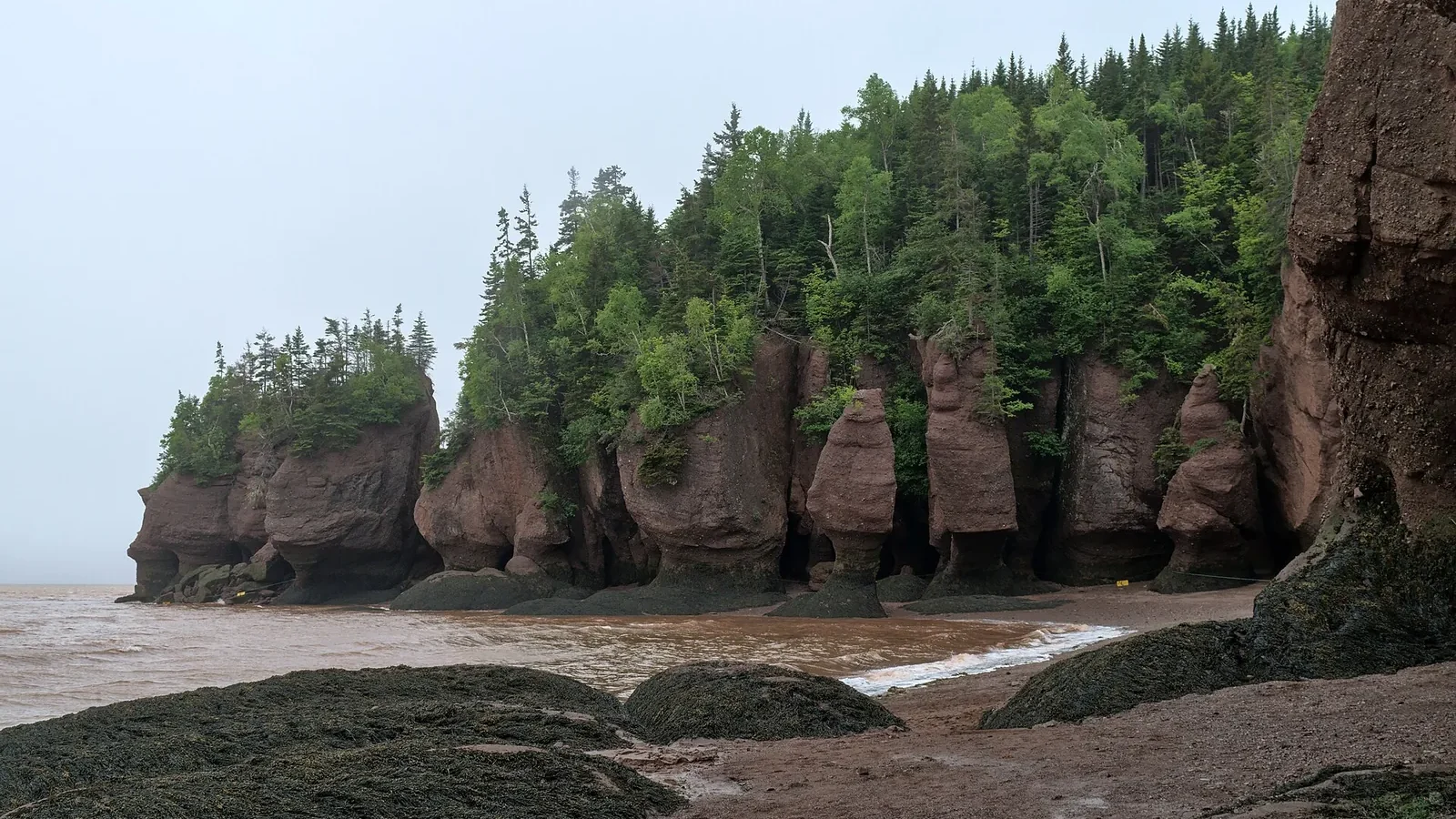
Hopewell Rocks Provincial Park is the bay’s most famous site. At low tide you take the stairs down to the sea floor and walk among eroded rock pillars topped with trees — the famous “flowerpots.” Six hours later, the same rocks are small islands you can paddle around in a kayak.
What to know (from NB Parks):
- 2026 season: May 15 to October 25, with hours that vary by period (longest in midsummer). Entering the park outside operating hours is prohibited for safety reasons.
- Your ticket is valid for two consecutive days, perfect for seeing both low and high tide.
- Ocean-floor access: usually from 3 hours before to 3 hours after low tide, at staff discretion. Aim to arrive 1–2 hours before low tide.
- Wear shoes you don’t mind getting muddy — parts of the floor are very slick.
The tide comes in fast
Follow staff instructions and leave the beach as soon as you’re asked. Don’t explore caves on a rising tide, and never visit out of season: there are no staff and safety barriers may be removed.
Fundy National Park and Alma
About 40 minutes from Hopewell Rocks, Fundy National Park protects a coastline of cliffs and coves and a forested plateau dotted with lakes and waterfalls. It’s open year-round, with full services mostly from May to October. Highlights:
- Dickson Falls: a 1.5 km loop (30–45 minutes) on boardwalks through a mossy, damp forest.
- Point Wolfe covered bridge and beach.
- Herring Cove, gorgeous at low tide.
- The Fundy Footpath, a multi-day coastal trek for experienced hikers (registration required).
The park is part of the Fundy Biosphere Reserve (UNESCO), and its dark skies make it a great place for stargazing. The village of Alma, at the park entrance, is the natural base: fresh lobster at the wharf and, at low tide, fishing boats sitting on the mud.
Cape Enrage in 2026
The Cape Enrage visitor site, with its 1838 lighthouse at the edge of a cliff, did not open for the 2026 season because of a lack of funding. Check the current situation before planning the detour.
Fundy Trail Parkway and St. Martins
Between St. Martins and the Sussex area, Fundy Trail Provincial Park is a scenic road of about 30 km, open seasonally (roughly mid-May to mid-October), with lookouts, beaches, waterfalls and trails. Don’t miss:
- Walton Glen Gorge, nicknamed the “Grand Canyon of New Brunswick,” with a viewing platform.
- The suspension bridge and the beaches reached by stairways.
- The St. Martins sea caves near the western gate — explorable only at low tide.
Saint John and St. Andrews
Saint John, the largest city on the Fundy coast, deserves half a day:
- The Reversing Falls: at low tide, the Saint John River pours into the bay in rapids; at high tide, the sea is higher than the river and the current reverses. Come at two different times to see it happen.
- Stonehammer UNESCO Global Geopark, North America’s first global geopark, covering nearly a billion years of geological history.
- The City Market, a historic covered market.
Farther west, near the Maine border, St. Andrews (Saint Andrews by-the-Sea) is a charming historic resort town and one of the best places for whale watching — humpback, minke and fin whales, and occasionally the endangered North Atlantic right whale — usually from June to October. At low tide you can drive across a sandbar to Ministers Island; check the tide times carefully.
Fancy an island? The ferry from Blacks Harbour goes to Grand Manan, known for its cliffs, lighthouses and whales.
Coming from the US
From Maine, the St. Stephen–Calais crossing puts you about 30 minutes from St. Andrews — a great first stop on a Fundy road trip. Bring a valid passport or other accepted travel document.
A 4-day New Brunswick itinerary
| Day | Plan | Overnight |
|---|---|---|
| 1 | St. Andrews: whale watching, Ministers Island at low tide | St. Andrews |
| 2 | Saint John (Reversing Falls, City Market), then St. Martins sea caves at low tide | St. Martins or Saint John |
| 3 | Fundy Trail Parkway (Walton Glen), then Fundy National Park (Dickson Falls, Point Wolfe) | Alma |
| 4 | Hopewell Rocks at low tide, back for high tide or a kayak tour | Moncton or Alma |
Shuffle days 2–4 around the tide table: the tides are in charge. From Moncton you’re less than an hour from Shediac and the Acadian coast — see things to do in New Brunswick.
The Nova Scotia side
The bay’s southern shore is just as rewarding. Get there by road (via Amherst) or on Bay Ferries’ Saint John–Digby ferry (about 2 hours 15 minutes in peak season).
- Burntcoat Head Park (Noel): site of the highest tides ever recorded. As at Hopewell, you can walk the sea floor within about 3 hours of low tide.
- Joggins Fossil Cliffs, a UNESCO World Heritage Site since 2008 for its “Coal Age” fossils.
- The Landscape of Grand Pré, a UNESCO World Heritage Site since 2012 and a powerful place of Acadian memory, with its ingenious dykelands.
- Cape Split, a hike to a headland above the bay’s churning currents.
- Tidal bore rafting on the Shubenacadie River, where the incoming tide surges upriver as a wave.
- Annapolis Royal and Digby, the scallop capital, with Digby Neck beyond for whale watching.
Where to stay around the Bay of Fundy
- St. Andrews: historic inns and B&Bs, the classic base for whale watching and Ministers Island.
- Saint John: the widest choice of hotels and restaurants, central for the Reversing Falls and St. Martins.
- Alma: small and seasonal, but right at the gate of Fundy National Park and 40 minutes from Hopewell Rocks. Book early.
- Moncton: plenty of hotels and an airport, handy for Hopewell Rocks and the Acadian coast.
- Park campgrounds: Fundy National Park has several campgrounds and oTENTiks, reserved through Parks Canada.
On the Nova Scotia side, Wolfville (wine country, near Grand Pré and Cape Split) and Annapolis Royal make lovely bases.
The Bay of Fundy with kids
Fundy is a giant outdoor science lesson. Kids love watching the tide fill a cove in a few hours, exploring tide pools at low tide and walking among the Hopewell Rocks “flowerpots.” In Fundy National Park, Dickson Falls (a 1.5 km loop) and the beach at Alma are easy wins. Bring rubber boots or old sneakers — the ocean floor is muddy — and keep a close eye on the clock: the tide comes in fast.
When to visit
- Mid-May to June: sites reopen, few crowds, everything green.
- July–August: high season, whales, calmer water for kayaking. Book Alma and St. Andrews early.
- September–October: fall colours in Fundy National Park, smaller crowds; Hopewell Rocks closes in late October.
- Winter: dramatic ice scenery, but most attractions are closed.
- A natural phenomenon found nowhere else, easy to enjoy with kids.
- Varied scenery: cliffs, forests, beaches, historic towns.
- Easy to combine with the Acadian coast and Prince Edward Island.
- Everything depends on the tides: each day needs planning.
- Cold water and frequent summer fog on the coast.
- Some sites are seasonal or close at short notice — check before you go.
Frequently asked questions
How high are the Bay of Fundy tides?
They’re the highest in the world. At Burntcoat Head, Nova Scotia, the average range is 14.5 m (47.5 ft) and the recorded record is 16.3 m (53.6 ft). At Hopewell Rocks the difference also easily exceeds 10 m.
What time should I go to Hopewell Rocks?
Check the park’s tide table and arrive 1–2 hours before low tide: the ocean floor is generally open from 3 hours before to 3 hours after. Your ticket is valid for two days, so come back for high tide.
How many days do you need for the Bay of Fundy?
Allow 3–4 days for the New Brunswick side (St. Andrews, Saint John, Fundy Trail Parkway, Fundy National Park, Hopewell Rocks) and 2–3 more for Nova Scotia.
Where is the best whale watching in the Bay of Fundy?
St. Andrews, Grand Manan and Digby Neck (Nova Scotia) are the top departure points, usually from June to October.
Can you swim in the Bay of Fundy?
The water is cold year-round and currents are strong. For swimming, head to the Acadian coast (Shediac, Kouchibouguac) or Prince Edward Island, where the water is much warmer in summer.
Sources
- NB Parks, Hopewell Rocks Provincial Park (dates, rates, tide tables): nbparks.ca
- NB Parks, Fundy Trail Provincial Park: nbparks.ca
- Parks Canada, Fundy National Park (hours, trails): parks.canada.ca/pn-np/nb/fundy
- Fisheries and Oceans Canada, Canadian Hydrographic Service tide predictions: tides.gc.ca
- Burntcoat Head Park (tides, records): burntcoatheadpark.ca
- CBC/Radio-Canada reporting on Cape Enrage’s 2026 closure: ici.radio-canada.ca
- Stonehammer UNESCO Global Geopark: stonehammergeopark.com
- UNESCO, Joggins Fossil Cliffs (2008) and Landscape of Grand Pré (2012): whc.unesco.org
- Bay Ferries, Saint John–Digby ferry: ferries.ca